Eating in Chinatown: Essentials
Hello! Below you’ll find some essential cultural knowledge that will help you eat well in Seattle’s International District/Chinatown. Enjoy, and let me know if you have questions! Jpv
Family style “banquet” “ordering off the menu” “à la carte” (les plats à partager)
This is where you order dishes to share with everyone at the table.
This option is fun for groups, three people or more.
“Family style” is the standard way to order at most Chinese restaurants. If you want to order your own plate without sharing, see “single plate meal” below. Many Chinese restaurants do not offer “single plate meals.”
Make sure to order a variety (meat, vegetable, rice or noodle, soup…). Don’t order five chicken dishes and no vegetables, that’s embarrassing.
Here’s the menu for Honeycourt Seafood on Weller St.
The traditional beverage is hot tea; drink a lot if the food is oily. Putting sugar in the tea is not culturally appropriate.
Eat Chinese food as soon as they bring it out; don’t let it cool down to start serving yourself (that’s embarrassing). Hot vegetables will taste spectacular; if you let them cool too much, they will taste like regular vegetables.
If you are not familiar with Cantonese food, I think you’ll like these)
Honey Walnut Prawns
Dry-fried green beans (they’ll ask you if you want it spicey or not)
Egg drop soup
Beef chow fun (dry!)
stir fried vegetables or Buddah’s Delight
Shrimp fried rice

Single plate meal (un menu)
This is the way most restaurant meals are served in North America, it’s so common that we don’t have a word for it. Chinese and Thai restaurants that cater to American clients sometimes offer a single plate meal, but have different words for it: “lunch special,” “combo/combination,” “plate lunch,” “set menu,” “lunch set.” These meals may be delicious and economical but not necessarily culturally authentic. On the TaiTung menu, scroll all the way down to “Combinations” On the Purple Dot menu, see “Rice dishes”
- These restaurants will have single plate meals that you don’t have to share:
Chinese noodle soup
- Hong Kong-Style Western cuisine
- Any Vietnamese restaurant
- Any Japanese restaurant
- Any Filipino restaurant
Lunch combo options (une formule)
These are offered in older Cantonese restaurants that cater to non-Chinese customers. On the TaiTung menu, scroll down “Family Style Dinners”
Dim Sum
This is the Hong Kong version of English tea; small dishes to share.
Traditionally, servers wheeled carts into the dining room; diners could choose what they liked when they saw it. During the pandemic, most dim sum restaurants switched to ordering from written dim sum menus with check-boxes. You can check off your own order with the pen they provide, or you can wait for the server.
Drink a lot of tea, it will settle your stomach.
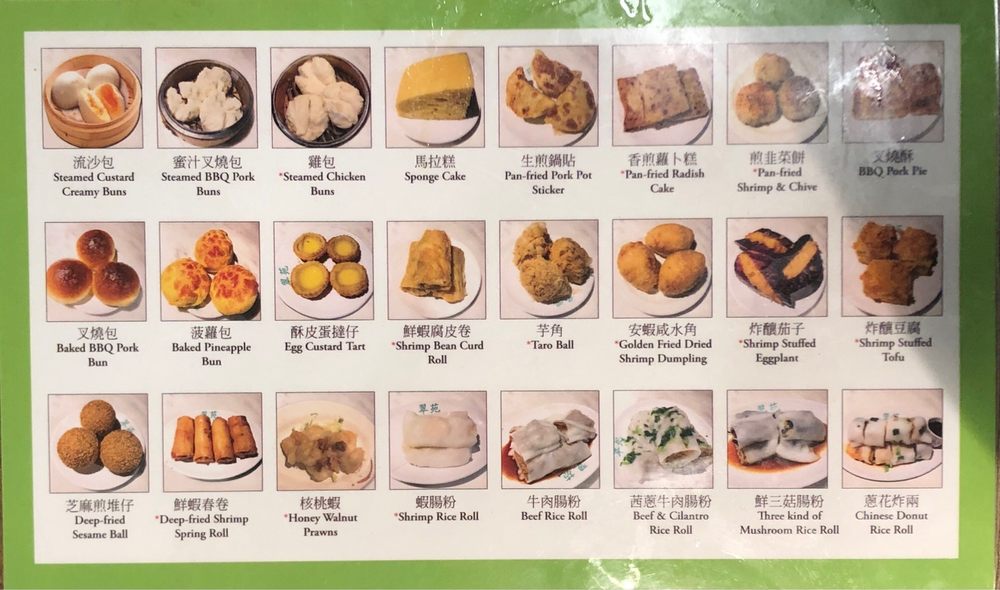
Here’s a picture menu from a Jade Garden; everything on this menu is friendly towards non-Asian customers.
If you’re not familiar with dimsum, here’s what I think you’ll like:
蝦餃 “hargow” steamed shrimp dumplings
叉燒包 bbq pork steamed buns
燒賣 “shumai” pork and shrimp steamed dumplings
春捲 fried spring rolls, usually pork
馬拉糕 steamed sponge cake
蛋撻 egg tart
How to pay:
Separate checks - Don’t do this when ordering family style.
Split it evenly - When the bill comes, everyone puts their credit card onto the tray. You may tell the server “split it evenly;” they’ll do the math.
“My treat” - This is when one person pays for the whole table. It is custom in many Asian cultures to argue over who gets the honor of treating the others.
If you don’t know how to use chopsticks:
Ask a friend to show you.
Ask the server for a fork and knife when you order. There’s no need to explain it to anyone, or apologize.
Comments
Post a Comment